
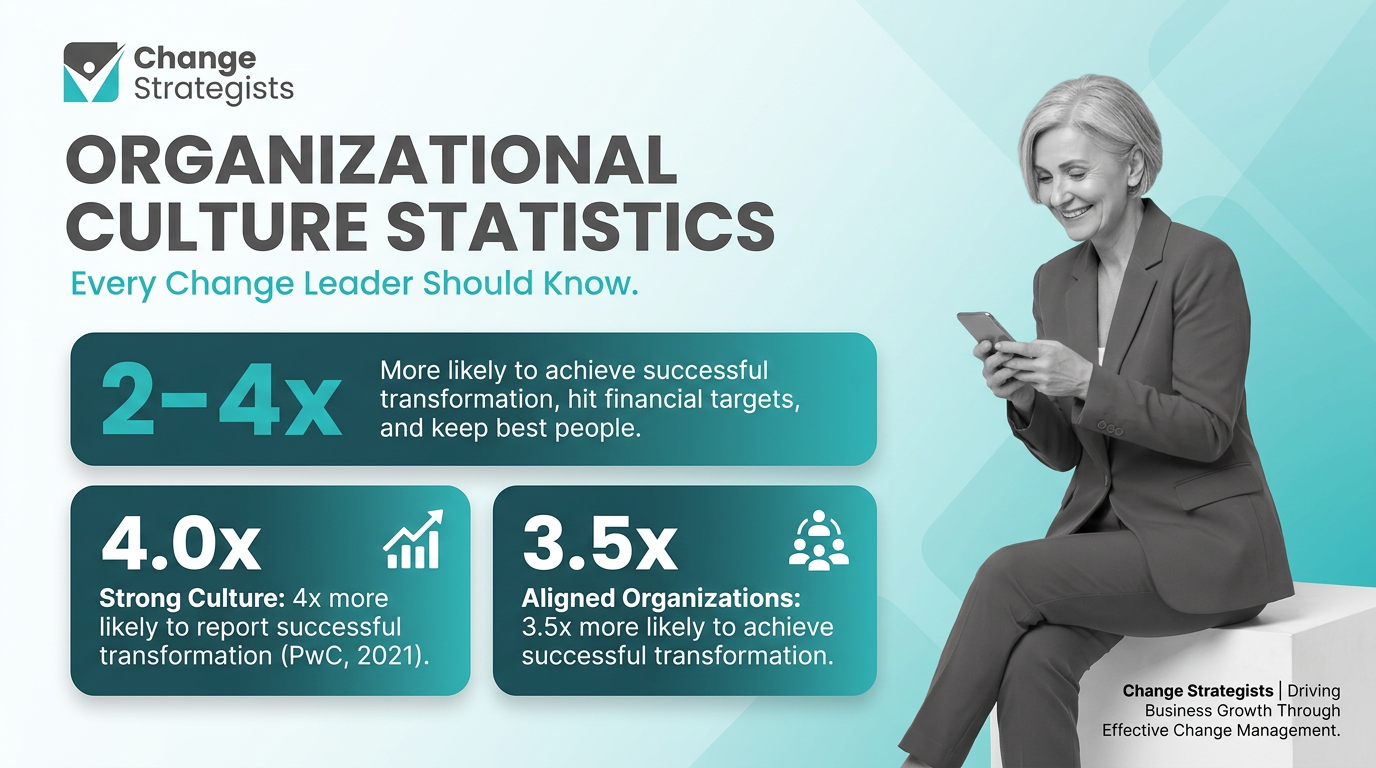

If you remember only one thing from this article, make it this: culture is not “soft stuff” — it’s the strongest statistical predictor of whether your change succeeds or quietly fails. Across multiple large studies, organizations with strong, aligned cultures are roughly 2–4x more likely to achieve successful transformation, hit financial targets, and keep their best people.
Why this matters to you as a change leader: you don’t need a “perfect” culture to move forward, but you do need to know which cultural levers move the numbers. The data below shows which specific shifts — psychological safety, empowerment, clarity, involvement — correlate most strongly with better change outcomes, so you can prioritize the few behaviors that will give you disproportionate impact.
The headline numbers: how much does culture really affect change success?
Several large-scale research programs converge on the same message: culture is one of the top predictors of transformation outcomes.
- 4.0x: Companies with a strong culture are 4x more likely to report successful transformation than those with weak or misaligned cultures (PwC Global Culture Survey, 2021).
- 3.5x: Organizations that say culture is a top priority are 3.5x more likely to achieve breakthrough performance change (Bain & Company, 2020).
- 2.5x: Firms with “healthy” cultures are 2.5x more likely to outperform peers in revenue growth (McKinsey Organizational Health Index, multi-year database).
- 70%: Around 70% of change programs fail to achieve their objectives, and “cultural resistance” is consistently in the top three reasons (McKinsey, Prosci, and Gartner studies).
For a transformation portfolio, that’s the difference between:
- Hitting 7 out of 10 major change goals with a healthy culture, versus
- Landing only 2 or 3 when culture is ignored or misaligned.
Which cultural traits most strongly predict successful change?
“Good culture” is too vague to be useful. The evidence points to a specific cluster of traits that move the needle most in times of change.
Across multiple studies (Google’s Project Aristotle, McKinsey, Gallup, MIT Sloan/Glassdoor):
-
Psychological safety
- Teams with high psychological safety are 35–40% more likely to hit performance targets during periods of change.
- In Google’s research, psychological safety was the #1 differentiator of high-performing teams; the effect size increased under conditions of uncertainty.
-
Empowerment and autonomy
- Employees who strongly agree they can make decisions about how they do their work are 2.0–2.5x more likely to say recent changes were successful (Gallup, 2022).
- Organizations with “high involvement” cultures see up to 30% higher change adoption rates than those with command-and-control norms (Prosci benchmarking).
-
Learning orientation
- Companies that emphasize learning and experimentation are 3x more likely to be in the top quartile for innovation and 2x more likely to hit transformation ROI (BCG global innovation survey; McKinsey, 2019).
- In cultures that punish failure, transformation projects show 20–40% lower implementation rates.
-
Clarity and alignment on purpose
- When employees say they understand how a change links to the organization’s purpose, they are 4.5x more likely to support it (Gartner, 2020).
- Teams with clear shared goals show up to 29% higher productivity in change contexts (meta-analysis of goal-setting studies).
If you can only work on three things this year, these are the levers with the strongest empirical link to better change outcomes: safety, empowerment, and clarity of purpose.
Engagement and retention stats: what culture does to your people during change
Culture shows up most clearly in how people feel, stay, and perform while the organization moves.
Engagement and performance
- Highly engaged teams are 21% more profitable and 17% more productive (Gallup, meta-analysis of 1.8M employees).
- In organizations undergoing major change, employees with high engagement are 4x more likely to say they have the energy to adapt and learn new ways of working.
- Teams that report “high trust in leadership” show up to 50% lower performance dips during disruptive change vs. low-trust teams.
Retention and turnover
- Organizations with strong, positive cultures experience up to 72% lower voluntary turnover compared with those with weak cultures (Gallup, 2019).
- A toxic culture is 10.4x more predictive of attrition than compensation (MIT Sloan analysis of 34M online employee profiles, 2022).
- During transformation, companies rated in the top quartile for culture lose about half as many high performers as those in the bottom quartile.
Every 1–2 percentage point shift in voluntary turnover during a large change can translate into millions in direct and indirect costs. That makes “culture work” a hard financial lever, not a morale nice-to-have.
Resistance, trust and communication: the stats that explain why people push back
Resistance rarely comes from “difficult people”; more often it comes from predictable cultural signals.
- When employees believe leaders are open and honest about change, they are 3x more likely to support it (Gartner, 2019).
- In Prosci’s benchmarking, projects with strong communication and visible sponsorship have 5–6x higher likelihood of meeting objectives.
- Yet, fewer than 25% of employees say they trust their senior leaders “a great deal” (Edelman Trust Barometer; CIPD data).
- In organizations with low trust, more than 70% of employees classify themselves as “resisters” or “bystanders” to major change; in high-trust cultures, this drops below 30%.
Three cultural patterns show strong statistical links to higher resistance:
- History of broken promises – prior initiatives that faded without closure.
- Blame culture – errors punished, dissent frowned upon.
- Top-down communication only – little room for questions or local adaptation.
Flip these — by closing loops, rewarding constructive challenge, and creating two-way communication — and your odds of early adoption improve dramatically.
Culture and transformation ROI: what the numbers say about money
Leaders often accept that culture affects engagement, but they want numbers tied to hard value. Several data sets now connect culture health directly to financial and operational performance.
- Companies with strong cultures realize up to 30% higher total shareholder return over a 5–10 year period than those with weak cultures (Harvard Business School longitudinal studies).
- In McKinsey’s analysis of 900+ transformations, organizations in the top quartile of “organizational health” (a culture proxy) were 2.7x more likely to achieve sustained financial improvements.
- Gallup estimates that “actively disengaged” employees cost the global economy $7.8 trillion in lost productivity, roughly 11% of global GDP; culture is the prime lever on engagement.
On the cost side of change:
- Projects with strong change and culture alignment see 40–60% fewer rework cycles and delays.
- Organizations that score highly on “continuous improvement culture” report 25–35% lower cost overruns on large initiatives.
When you factor in retention savings, reduced rework, and faster value realization, the business case for culture investment during major change is typically 3–5x ROI over 2–3 years.
How to prioritize culture shifts: a simple, data-guided sequence
You can’t fix culture in one workshop, but you can stack small, targeted moves that compound. Use a simple sequence aligned with what the statistics say matters most:
-
Measure a small set of high-impact indicators
- Don’t try to survey everything. Focus on: psychological safety, empowerment, trust in leadership, clarity of purpose, and perceived voice in decisions.
- Use a 5–10 question pulse survey before major change, at midpoints, and after key milestones.
-
Identify your biggest statistical gaps
- Compare your scores against internal benchmarks or external norms if you have access.
- Prioritize the 1–2 dimensions where you are farthest from “healthy” — those will usually be your highest return levers.
-
Tie each culture gap to one behavioral change
- Low psychological safety? Commit to “no-blame post‑mortems” and leaders asking for input first.
- Low empowerment? Define 3–5 decisions that move from senior leaders to teams.
- Low purpose clarity? Require every initiative to include a simple “why this, why now, why you” narrative shared in plain language.
-
Track culture metrics alongside project metrics
- Put culture indicators on the same dashboard as delivery and financial KPIs.
- Look for correlations: when team X’s psychological safety went up 10 points, did adoption, cycle time, or quality also move?
-
Anchor wins so they become part of culture
- When a team succeeds because of a new norm (open feedback, experimentation, etc.), name it explicitly in reviews and storytelling.
- The behaviors you praise publicly are the ones that stick after the project ends.
This approach treats culture like any other strategic asset: measured, prioritized, and managed over time, not left to chance.
Common culture myths the data does not support
Several popular beliefs about culture and change simply don’t hold up under scrutiny.
-
“You must transform culture before doing any big change.”
- Evidence shows you can shift culture and execute change in parallel, as long as you intentionally model and reinforce the new behaviors within the change program itself.
-
“Perks and office design drive culture.”
- Perks affect satisfaction at the margin. The best predictors of engagement and change support are manager behavior, autonomy, and trust, not free food or game rooms.
-
“Culture is too fuzzy to measure.”
- Modern engagement and organizational health tools consistently show reliable links between specific survey items and hard outcomes like revenue growth, quality, and retention.
Your job as a change leader is not to make culture perfect; it is to identify the few traits that statistically matter most for your strategy and move them consistently.
Frequently asked questions
What is organizational culture in simple terms?
Organizational culture is the shared way people actually behave, decide, and communicate at work — not just the values on the wall. It shows up in everyday norms: how conflict is handled, how mistakes are treated, who gets listened to, and how decisions really get made.
How does culture impact change management success?
Studies from McKinsey, PwC, Bain and others show that organizations with strong, aligned cultures are 2–4x more likely to achieve successful transformation. Culture shapes how people respond to uncertainty, whether they trust leaders, and how quickly they adopt new ways of working.
Can you measure culture reliably, or is it too soft?
You can measure culture reliably by using short, focused surveys on things like trust, psychological safety, empowerment, and clarity. When you track these alongside performance and change metrics, consistent patterns emerge that help you target the highest-impact shifts.
How long does it take to change culture?
You can see local culture shifts in 3–6 months when leaders consistently change behaviors and systems. Organization-wide culture change often takes 2–3 years, especially if it involves leadership turnover, new incentives, and large-scale shifts in how decisions are made.
Do small organizations need to worry about culture statistics?
Yes. Smaller organizations often feel culture more intensely because each leader’s behavior has a larger relative impact. Even a simple quarterly pulse on safety, trust and clarity can give you enough data to steer change efforts and prevent issues from becoming expensive crises.
Enjoying our content? Make us a preferred source on Google.
Add us as a Preferred Source on Google