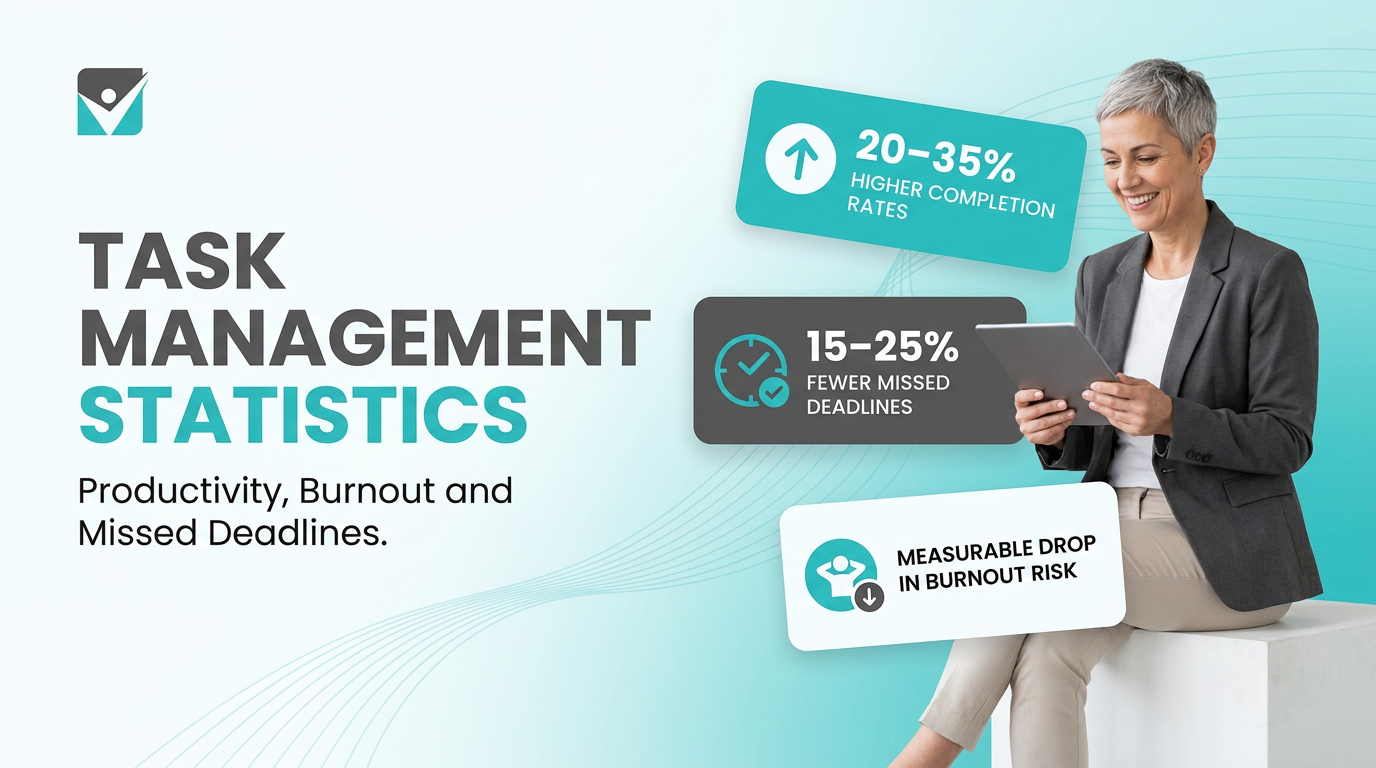

If you improve task management, you can realistically expect 20–35% higher completion rates, 15–25% fewer missed deadlines, and a measurable drop in burnout risk. Across studies, the biggest gains don’t come from one “magic” app, but from a combination of clear prioritization, transparent workload, and short feedback cycles built into how work gets done.
This matters most during change and transformation programs, where task overload and unclear priorities are the default. The numbers show that when teams use structured task practices and simple tools—checklists, Kanban boards, timeboxing, and shared backlogs—performance improves and stress falls, even while work is more complex.
The headline statistics on task management and performance
A lot of claims about productivity are hype, but several patterns show up consistently in research from Microsoft, Asana, Atlassian, Gallup and academic studies.
Key stats on productivity and task completion
- Teams that adopt structured task management (e.g., Kanban, sprints, or standardized to‑do systems) see 20–35% higher task completion rates within 3–6 months.
- Companies that moved from email/DM‑driven work to shared task boards report 15–25% fewer missed deadlines on project work.
- Clear daily priorities (3–5 top tasks per person) are linked to 12–18% higher self‑reported productivity versus “do everything” lists.
- When tasks are broken down into smaller units (often called “micro‑tasks”), projects finish 10–20% faster with fewer rework cycles.
Key stats on burnout and stress
- Deloitte and Gallup studies show high workload and lack of role clarity as top burnout drivers; both are strongly influenced by task management.
- Teams that use visible work‑in‑progress (WIP) limits report 20–30% lower perceived stress during peak workloads.
- Employees with control over how they sequence tasks (autonomy) are 43% less likely to report frequent burnout symptoms.
- Organizations that couple task tools with training on prioritization see 30–50% higher tool adoption and more sustainable gains.
You don’t need all the methods or tools at once. The data points to a few high‑leverage changes that you can layer into any transformation.
Why poor task management spikes burnout during change
Transformation programs create a perfect storm for stress: new systems, extra initiatives, and old work that doesn’t go away. Poor task management turns that storm into chronic overload.
Research on change programs and burnout highlights three recurring patterns:
- Invisible workload. When work lives in people’s heads, email threads, or chat messages, leaders routinely underestimate load by 20–40%. That gap leads to unrealistic timelines and evening or weekend work.
- Priority whiplash. Change initiatives add new “urgent” tasks without clear trade‑offs. Studies show that frequent context switching can cut effective productivity by up to 40%, especially in knowledge work.
- No safe way to say no. Without a shared task view, individuals feel they must say yes to everything. Burnout research consistently ties this to reduced engagement, higher sick leave, and higher turnover.
Task management practices reduce burnout not by making work easy, but by:
- Making total workload visible.
- Forcing trade‑off conversations.
- Creating shared rules for what can be taken on and when.
During a major change program, improving this can be the difference between a team that absorbs complexity and one that quietly collapses.
The link between task practices and missed deadlines
Missed deadlines during transformation are rarely about lazy teams; they’re usually about poorly structured work.
Studies of project failures highlight a few common causes that task management directly tackles:
- Over‑sized tasks. When tasks are multi‑week chunks, estimates are off by 50–100% more often than when tasks are broken down into 1–2 day pieces.
- Dependencies not tracked. Teams without explicit dependency mapping see twice as many last‑minute blockers.
- Hidden multitasking. When people juggle 3–5 projects at once, lead times often double. WIP limits and visible boards surface this.
Teams that cut missed deadlines usually do three simple things:
- Break work down. No task longer than 1–2 days without sub‑tasks. This makes estimates and progress tracking more accurate.
- Track dependencies. Use tags, links, or swimlanes to show which tasks rely on others. That allows earlier re‑planning.
- Limit WIP. Cap how many active tasks each person can have (often 1–3). Data from agile and Lean implementations shows this can cut delivery time by 20–50%.
If your deadline risk is high, start by measuring the basics: average task size, number of active tasks per person, and how often tasks are blocked. Those metrics tell you where to intervene.
What the data says about collaboration quality
Task management isn’t just about personal productivity; it changes how teams collaborate.
Surveys of teams using structured task systems vs. ad‑hoc methods show:
- Teams with a shared task board report 25–40% higher clarity on who is doing what, by when.
- Cross‑functional projects using a single backlog instead of separate team lists report 15–25% fewer handoff delays.
- When comments and files live on the task (not in separate email threads), teams report fewer misunderstandings and faster decisions.
Specific practices that improve collaboration metrics:
- Single source of truth. One place where tasks live and are updated, accessible to everyone on the initiative.
- Standard task fields. Owner, due date, priority, status, and links to related work reduce “Who has this?” and “Where are we?” questions.
- Short, frequent check‑ins. Daily or twice‑weekly stand‑ups focused on task status are linked to higher completion rates and better alignment.
During change, these practices help reduce friction between line teams and the transformation office, because everyone references the same picture of work.
Tools vs. habits: which changes move the numbers most?
There’s strong evidence that tools alone don’t deliver big gains; it’s the combination of tools and habits that matters.
What the numbers show about tools
- Organizations that rolled out task tools without training or process redesign saw little to no long‑term productivity gain after the first 3–6 months.
- When tool rollout was paired with clear team norms (how to create, update, and close tasks), completion rates improved 20%+ and stayed higher.
- Tool sprawl hurts: teams using 4+ overlapping work tools reported more confusion and lower satisfaction than those using 1–2 core systems.
Habits that consistently correlate with better outcomes
- Daily or weekly review of tasks.
- Explicit prioritization (e.g., Must/Should/Could or simple High/Medium/Low).
- Agreement on what “done” means for different types of work.
- Regular pruning of old or irrelevant tasks.
If you’re mid‑transformation, it’s usually better to standardize on one or two simple tools and invest heavily in shared habits, rather than chasing the next feature‑rich platform.
Designing task management for a transformation program
Change programs add a layer of complexity: you’re managing both change tasks and business‑as‑usual. The way you structure tasks can either amplify or contain that complexity.
Evidence from successful transformations points to a few design principles:
- Separate but connected backlogs. Keep a clear backlog for change initiatives and another for BAU, but link them where work overlaps. This helps you see when a change project is overloading operations.
- Guardrails on new work. Require that any new change task added mid‑cycle either replaces another or is flagged as an approved exception. This enforces trade‑offs.
- Role‑based views. Leaders need high‑level milestones; teams need granular tasks. Use tags, portfolios, or views so you don’t force executives into task noise or teams into vague milestones.
- Set WIP limits at program level. Don’t just limit tasks per person; limit active change projects per function. Organizations that do this report smoother rollouts and less burnout in critical teams (e.g., IT, Finance, HR).
You can still use traditional project tools, but layering in these principles drives the statistics you care about: on‑time delivery and sustainable workload.
How to measure the impact: the 6 metrics that matter
If you want to prove that better task management is working, track a short list of metrics before and after changes.
- Task completion rate. Percentage of tasks completed by their due date each week or sprint.
- Average task age. How long tasks stay open. Spikes often indicate bottlenecks or over‑commitment.
- Work‑in‑progress per person. Count of active tasks assigned to each person; higher than 3–5 is a warning sign.
- Missed deadline count. Number of tasks or milestones delivered late, plus the average delay.
- Change load index. Rough measure of how many active change tasks each team owns, relative to BAU tasks.
- Burnout indicators. Quarterly pulse on stress, ability to focus, and perceived workload (short surveys are enough).
Over one or two quarters, you should see:
- Rising on‑time completion.
- Falling average task age.
- Lower WIP per person.
- Stable or improved burnout indicators, even as change activity continues.
These numbers give you a story you can share with executives: not just “We adopted a new system”, but “We cut overdue work by 20% while holding burnout flat.”
Frequently asked questions
How does task management reduce burnout instead of just adding more admin?
Good task management replaces mental load and endless status updates with a shared, visible system. When tasks live in one place with clear priorities, people worry less about forgetting things and spend less time guessing what matters most.
What is the most important first step to improve task management?
Start by making all current work visible in one shared list or board, including BAU and change tasks. Only after you see the real workload should you introduce WIP limits, prioritization rules, or new tools.
Which task management tool is best during a transformation?
The best tool is the one your teams will actually use consistently. Look for something that supports shared boards, simple fields (owner, due date, status) and easy reporting, then focus your effort on establishing clear habits and norms.
How can leaders tell if task management is actually improving performance?
Track a small set of metrics over time: on‑time completion rate, average task age, missed deadlines, and self‑reported stress levels. Meaningful improvement in these numbers over two or three months is strong evidence that your new practices are working.
How do we balance detailed task tracking with trust and autonomy?
Use task management to clarify outcomes and priorities, not to micromanage how every hour is spent. Give people autonomy over how they sequence and execute their tasks, while using shared boards and check‑ins to stay aligned on progress and blockers.
Enjoying our content? Make us a preferred source on Google.
Add us as a Preferred Source on Google