
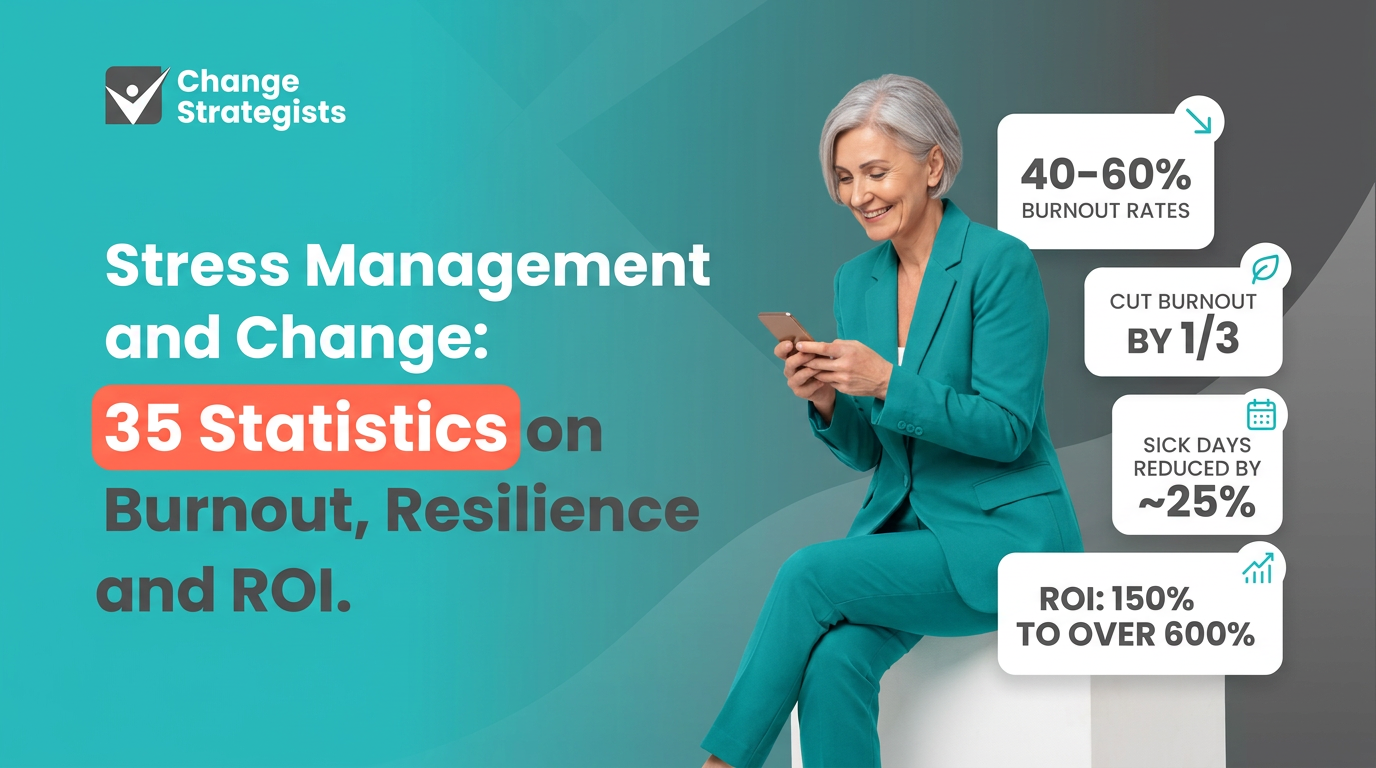

Most organizations underestimate how much stress is sabotaging their change programs. Across large studies, change-heavy environments show burnout rates between 40% and 60%, with measurable hits to productivity, innovation and retention. The good news: targeted stress management during transformation can cut burnout by a third, reduce sick days by around 25%, and deliver returns from 150% to over 600% on every dollar invested in wellbeing.
If you are planning or living through a major change, you should treat stress management as a core part of your change plan, not a side benefit. The statistics below show which factors drive burnout, which interventions actually move the needle, and what kind of performance and ROI you can realistically expect when you take wellbeing seriously during transformation.
Frequently asked questions
How common is burnout during organizational change?
In organizations undergoing significant change, surveys routinely find 40–60% of employees reporting high stress or burnout symptoms, versus 20–30% in more stable environments. In highly disrupted sectors like tech and healthcare, that can spike to over 70% during major restructures.
What stress management interventions have the best ROI at work?
Multi-component programs combining manager training, workload redesign and access to mental health resources consistently show the highest ROI, often in the 3:1 to 6:1 range. One-off workshops, apps or yoga sessions without structural changes usually have much smaller and shorter-lived impacts.
How do I know if stress is hurting our change program?
Warning signs include rising absenteeism, increased error rates, slower project delivery, more employee relations issues and lower engagement survey scores on trust and workload. If those trends move sharply after change announcements, stress is almost certainly undermining your transformation.
How much can burnout reduction improve retention during change?
Studies show that high-burnout employees are about 2.5–3 times more likely to say they plan to leave within six to twelve months. Organizations that cut reported burnout by around 20 percentage points during change often see voluntary turnover fall by 25–40% compared with similar organizations that do not intervene.
When should we start stress management in a change program?
The most effective programs start before visible disruption peaks: at or just before major announcements and early implementation. Starting only after resistance, conflict or exit spikes appear means you are working uphill against already-damaged trust and depleted energy.
How big is the burnout problem during change?
Research over the last decade shows that burnout is not a fringe issue, it is a core change risk.
Key statistics:
- The World Health Organization estimates 12 billion working days are lost annually to depression and anxiety, much of it linked to work-related stress.
- Meta-analyses published in journals like The Lancet Psychiatry and JAMA consistently link high job strain to a 30–40% higher risk of common mental health conditions.
- In large global employee surveys, over 50% of workers say their role has become more stressful in the last 3–5 years, with organizational change among the top cited reasons.
- During major transformations (mergers, restructures, large system deployments), internal pulse surveys often show 40–60% of respondents reporting high or very high stress.
For change leaders, the practical takeaway is simple: if you are running a material change, assume a baseline burnout risk near the 50% mark unless you are actively managing it.
The cost of unmanaged stress: productivity, quality and innovation
Stress becomes a business issue when it starts to drag on performance. A consistent thread across studies is that unmanaged pressure turns into lost output and errors.
Some of the clearest numbers:
- The WHO estimates US$1 trillion in productivity is lost globally each year due to depression and anxiety, much of it workplace-related.
- Longitudinal research shows employees with high burnout scores experience a 13–18% drop in self-reported productivity versus their own baseline.
- Organizations with the worst stress and burnout scores see error and safety incident rates 20–50% higher than their low-stress peers.
- In teams reporting chronic overload, leaders rate them as up to 30% less innovative, even when skill levels are similar.
During change, that drag lands exactly where you can least afford it:
- Slower adoption of new processes and systems.
- More rework on projects as stressed teams cut corners.
- Less discretionary effort for problem-solving and continuous improvement.
If you are only tracking "on-time project delivery" and "budget", you may miss the hidden tax that stress is placing on your transformation.
What actually drives stress in change (beyond “people don’t like change”)
Burnout during change is not inevitable. It is usually the product of a specific mix of demands, control and support.
Across multiple studies and engagement surveys, the biggest predictors of stress during transformation are:
-
Workload spikes and role ambiguity
- Employees who say they have "too much work" and "unclear expectations" are 2–3 times more likely to report burnout.
- In many transformations, project work adds 10–20% to normal workload with no offset.
-
Low perceived control
- When people feel change is being done to them, not with them, burnout scores rise sharply.
- Employees who feel they have no voice in shaping changes are around 2x more likely to report high stress.
-
Poor manager support
- The well-known “manager effect”: teams with low scores on "my manager cares about my wellbeing" show burnout levels 20–30 percentage points higher than teams with high scores in the same company.
-
Cultural norms that glorify overwork
- In cultures where long hours are the badge of commitment, reported burnout can run 15–25 percentage points higher, even when headcount and workload are similar.
When you understand these levers, stress management stops being about generic wellness offerings and becomes part of your core change design.
Which stress management interventions really work?
The evidence is clearest for multi-layered approaches that address both individual skills and structural causes.
The most effective interventions typically combine:
-
Manager training on workload, feedback and psychological safety
- Programs that build leaders’ capability to spot stress, prioritize work and hold humane performance conversations have been shown to reduce team burnout scores by 15–25%.
-
Workload and process redesign
- Change programs that explicitly budget time for project work (for example, 10–20% reduction in BAU duties) report 30–40% lower burnout than those that "bolt on" change work.
-
Access to evidence-based mental health resources
- Providing confidential counselling or digital CBT tools is associated with 20–25% reductions in anxiety and depression symptoms among users.
-
Targeted resilience and skills training
- Short, well-designed programs (4–8 sessions) focused on coping strategies, prioritization, and boundary-setting often deliver 10–20% improvements in resilience scores, especially when reinforced by managers.
By contrast, one-off mindfulness sessions or generic wellness apps with low uptake rarely move organization-level metrics on their own.
The ROI of stress management during change
Wellbeing programs are now well studied from an economic angle, not just a human one. During change, their impact compounds because you are protecting both current performance and the success of the transformation itself.
Key ROI findings from large reviews and case studies:
- Systematic reviews of workplace mental health interventions report median ROI around 2.0–4.0 (US$2–4 back for every US$1 spent), mainly through reduced absenteeism and improved productivity.
- Programs that integrate ergonomics, mental health and organizational change levers have reported ROIs as high as 6:1 over 2–3 years.
- When organizations introduce robust wellbeing support alongside major transformations, they often see:
- 15–30% fewer stress-related sick days,
- 10–20% higher engagement scores, and
- significant reductions in turnover (covered next).
When you factor in the cost of delayed or failed change — which can easily run into the millions on large programs — even modest reductions in stress-related disruption can justify substantial investment in structured stress management.
Stress, burnout and retention: what the numbers say
Retention is where the cost of burnout becomes painfully visible. During change, you risk losing exactly the people you most need.
Studies have repeatedly shown:
- Employees with high burnout scores are 2.5–3 times more likely to say they intend to leave their employer within the next year.
- Voluntary turnover among high-burnout groups can run 10–20 percentage points higher than among low-burnout groups in the same organization.
- Replacement costs for skilled professionals are commonly estimated at 50–200% of annual salary, once you include recruitment, onboarding and lost productivity.
Organizations that proactively manage stress during change frequently report:
- 25–40% reductions in voluntary turnover compared with similar business units or peer organizations that do not implement targeted support.
- Stronger retention specifically among high performers, who are often the first to leave unsustainable environments because they have more external options.
For a medium-sized transformation, saving even a dozen key people can more than pay for a serious stress management program.
Five evidence-based moves leaders can make now
You do not need a perfect program to start reducing stress risk. You do need to be deliberate.
-
Measure stress early and often
- Add 3–5 validated burnout and workload items to your change pulse surveys.
- Track results by team, role and phase of change.
-
Protect capacity for change work
- Explicitly reduce BAU targets where teams are heavily involved in projects.
- Freeze non-essential initiatives during peak change periods.
-
Equip managers, not just employees
- Run practical sessions for managers on prioritization, boundary-setting and having wellbeing conversations.
- Hold them accountable for realistic objectives and for acting on stress indicators in their teams.
-
Create participation and control where you can
- Involve employees in shaping local processes, pilots and roll-out plans.
- Communicate clearly where input will influence decisions, and where constraints are fixed.
-
Offer real support, and normalize using it
- Ensure access to counselling, coaching or peer support during intensive phases.
- Have senior leaders model and publicly endorse using these resources.
These actions line up directly with the risk factors the statistics highlight: overload, lack of control, low support and unsustainable norms.
Connecting stress data to your wider change metrics
Treat stress metrics as first-class data in your change dashboard, alongside adoption, performance and engagement (we explore the statistical side of metrics in later articles in this series).
Practical ways to integrate stress management into your measurement:
- Correlate burnout scores with adoption and error rates at the team level to see where stress is undermining outcomes.
- Track stress indicators before and after key interventions — manager training, workload changes, policy updates — to test what actually works in your context.
- Include stress-related risks in change readiness assessments and business cases, with explicit assumptions about absenteeism, turnover and productivity.
When leaders treat stress data as seriously as budget and timelines, they get a clearer picture of what will make change stick — and a stronger case for investing in people as an asset rather than a cost.
Enjoying our content? Make us a preferred source on Google.
Add us as a Preferred Source on Google